AI Adoption Needs a Mindset Shift, Not Just a New Tool
Many small businesses are already operating reasonably well.
The work gets done. Customers are served. Invoices go out. Staff know the processes. The business moves forward.
That is exactly why AI adoption can feel difficult.
For many SMEs, the challenge is not a lack of tools. It is the shift in thinking required to look at a familiar process and ask a much bigger question:
If we were starting this workflow again today, how would we design it?
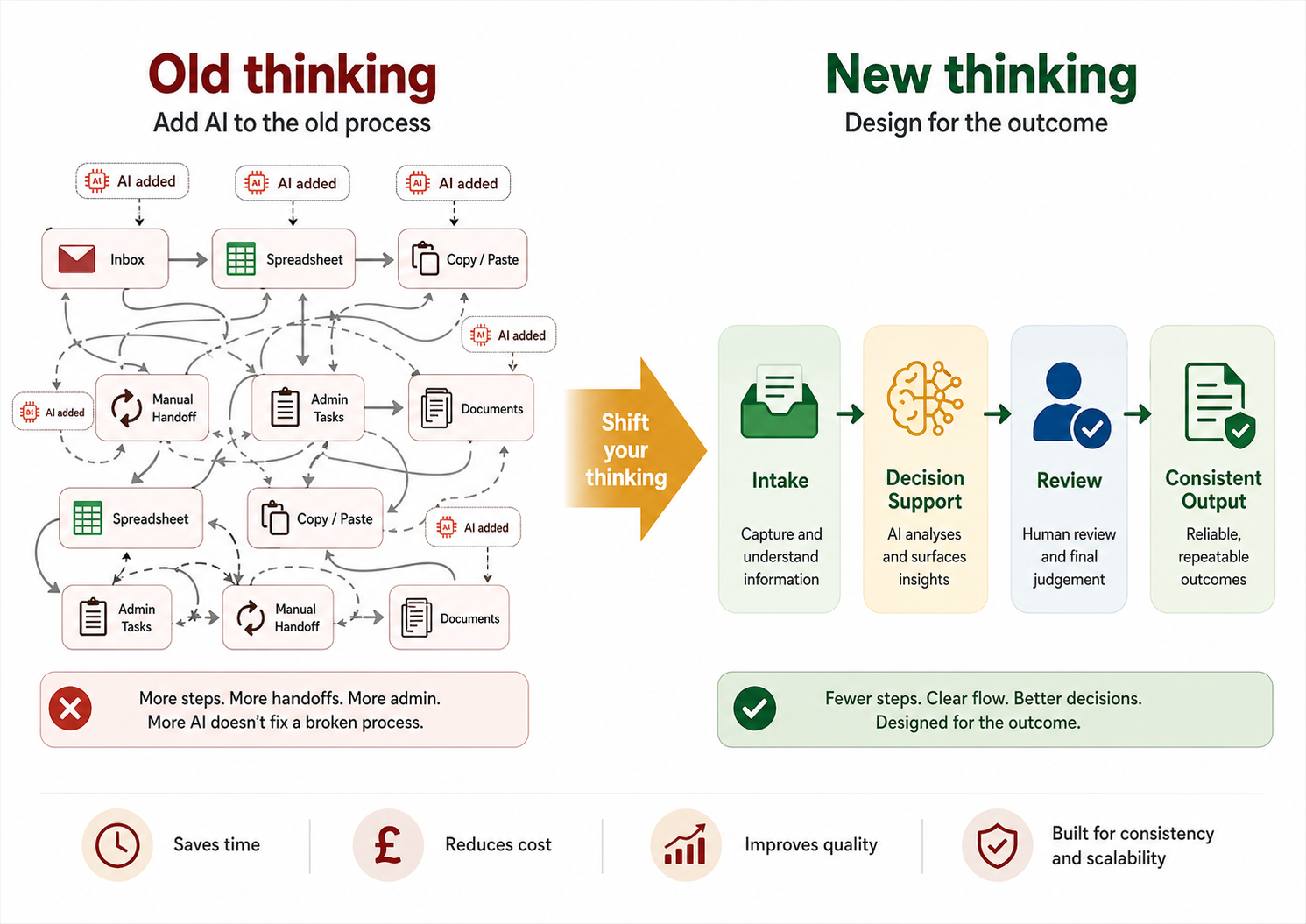
Adding AI to an old process has limits
A common starting point is to take an existing manual process and add an AI tool somewhere in the middle.
That can help in some cases, but it often leaves the bigger opportunity untouched.
If a process has been built around spreadsheets, inboxes, repeated copying and pasting, or people remembering the next step, then AI may only make one small part of that process faster.
The stronger opportunity is to step back and look at the whole workflow.
What is the actual outcome you need?
Where does work slow down?
Where do mistakes happen?
Where are people repeating the same judgement or wording every day?
What would the best version of this process look like?
That is where AI starts to become useful for everyday business operations.
Start with the best case, then work backwards
SMEs do not need to chase unrealistic transformation projects.
A better approach is to imagine the best practical version of a workflow, then work backwards towards something achievable.
For example, instead of asking, "How can AI help us write this email faster?", ask:
"What would a smoother customer enquiry process look like from start to finish?"
That question may lead to better templates, clearer intake questions, faster routing, improved follow-up, or a simple assistant that helps draft consistent replies.
You may not reach the perfect version immediately. That is fine.
The useful starting point is often somewhere between the current process and the desired future process.
Learning creates better decisions
AI also brings important questions around security, compliance, quality, and control.
Those questions matter.
However, they are often easier to answer once a business has started testing AI in a focused and low-risk way. When people experiment with real workflows, the questions become more specific. The feedback loop improves. The team starts to understand what needs guidance, what needs review, and where AI should stay out of the process.
A simple starting point:
- Define the problem.
- Describe the current process.
- Explain what a good output looks like.
Those three steps can help turn a repeated task into the first draft of a useful internal assistant.
The real shift for SMEs
AI adoption is partly about tools, but more importantly, it is about imagination.
It asks business owners and teams to accept that some processes can be redesigned, simplified, or supported in ways that were difficult before.
For SMEs, the opportunity is practical. Less repeated admin. More consistency. Clearer workflows. Better use of people's time.
The businesses that benefit will likely be the ones that start learning now, ask sensible questions as they go, and redesign their workflows with care.
If you are ready to look at where AI and automation could fit into your business operations, get in touch with AxioFlow to start a practical conversation.
Emmy Mukasa
Founder, AxioFlow
Ready to put this into practice?
Take our free 5-minute Operational Health Check and get personalised recommendations to streamline your business.
Take the Health CheckYou might also like
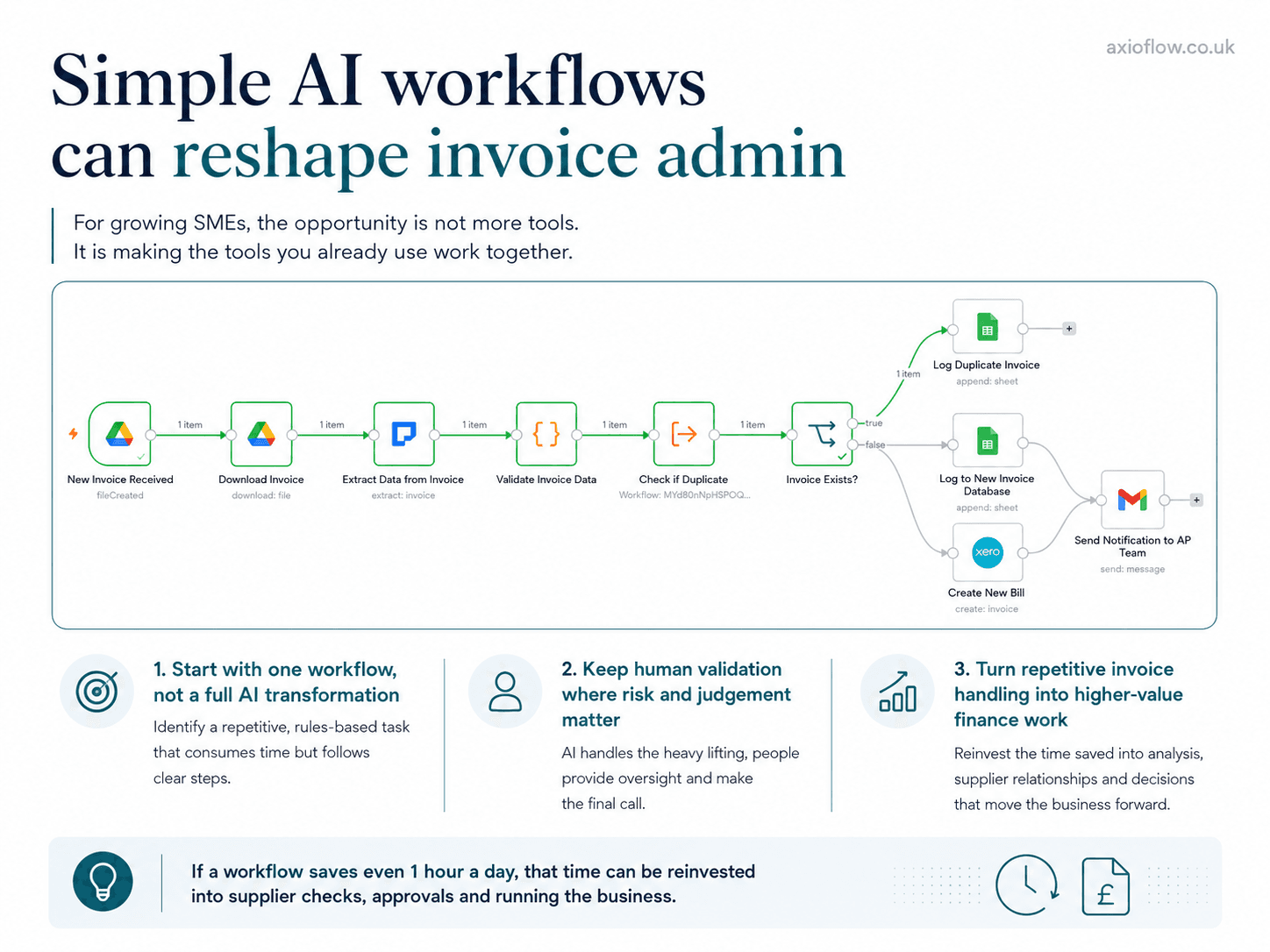
How a Simple Invoice Workflow Can Give SMEs Hours Back Every Week
Invoice processing becomes painful not because any single task is hard, but because the same small manual steps repeat every day. Here is what a better workflow looks like.
What Most Small Businesses Don't Realise About AI
It is not coming for your job. It is not only for tech companies. And it does not cost a fortune to start. Here is what AI actually looks like inside a small business — and why the gap between businesses using it and those not is widening faster than most people think.
How AI Is Changing Operations for UK SMEs in 2026
AI is no longer just for large enterprises with deep pockets. Practical, affordable AI tools are now accessible to small and medium businesses. Here is what is actually working and where to start.