
What Most Small Businesses Don't Realise About AI
Let us be honest. When someone says "AI", most small business owners picture Silicon Valley boardrooms, robotics factories, or a sci-fi dashboard that costs £50,000 to build. That image is doing a lot of damage, because it is keeping real, hard-working businesses stuck doing things the slow way.
I talk to SME owners regularly. And the pattern is almost always the same. They are smart, capable people who are stretched thin, wearing five hats at once, and spending chunks of their week on things they know are inefficient but have not had time to fix. When I mention AI, there is often a pause. "That's not really for businesses like mine," is the usual response.
It is. And the numbers are starting to show it.
Where UK SMEs actually stand right now
Here is a snapshot from recent research, including data from the British Chambers of Commerce, YouGov, and Moneypenny's 2025 survey of 750 UK business decision-makers.
So a third of SMEs are using AI, but only 11% say they are actually using it well for operations. That is not a technology problem. That is an awareness and application problem.
"Only 33% of SMEs now have no plans to use AI at all, down from 43% the previous year. The direction of travel is clear."
And here is what is interesting about who is still sitting on the fence: the top barriers cited by non-adopters are concerns about data privacy, not seeing the value, and thinking it is too complex. Which makes sense, because most of the AI coverage in the press focuses on the high-end enterprise stuff, not the tools a 10-person plumbing business or a 25-person recruitment firm could use tomorrow morning.
So let us make it practical. Here are two real-world scenarios — the kind of day-to-day business activities that eat hours every week — and what they look like with and without AI.
Example 1: Responding to new enquiries
Picture a small property management company with a team of eight. Every day, new enquiries land in their inbox: prospective tenants, landlords, maintenance requests. Someone has to read each one, work out what is being asked, and write a reply. Then follow up if there is no response. Then log it somewhere.
It is nobody's main job. So it sits in someone's inbox, half-answered, until they have a moment. Leads go cold. Landlords go elsewhere. A member of staff is permanently in reactive mode.
The comparison
That time estimate is based on a team member earning around £28,000 to £35,000 a year. Four hours a week of their time, freed up to do higher-value work. Not replaced. Redirected.
Example 2: Weekly reporting and performance tracking
Now picture a small logistics and courier company. Every week, the operations manager puts together a performance update: delivery times, failed attempts, vehicle utilisation, client feedback. The data lives across three spreadsheets, a WhatsApp group, and a booking system. Someone has to pull it all together, write it up, and share it.
It takes two to three hours every Friday afternoon. Every single week. And half of next week's problems have already happened by the time the report is done.
The comparison
The real value here is not just the hours. It is the quality of the decision-making. When a business owner spends two hours copying data on a Friday, they are not thinking clearly about what the data means. When AI does the heavy lifting, that same owner is making sharper calls on Monday morning.
So what is actually stopping SMEs?
It is not money. Many of the tools that would handle both scenarios above start at £20 to £100 per month. The cost of not using them, as the numbers above show, is considerably higher.
The real barrier is knowing where to start. Which tool does what. How to connect things without hiring a developer. And whether the effort of setting it up is worth it for a business with limited time and no dedicated IT team.
That is a fair concern. But it is a process problem, not a technology problem. And process problems are solvable.
The businesses pulling ahead right now are not doing anything revolutionary. They have mapped out where their time goes, identified the tasks that are repeatable and rules-based, and plugged a tool in. That is it. No AI consultant charging £500 a day. No six-month implementation project. Just a clear view of the problem and the right starting point.
A note before you go
If you read this and thought "we definitely do both of those things manually", you are not alone. Most SMEs have three or four of these hidden time drains running in the background every week. They are not obvious because they have always been there.
The first step is just seeing them clearly.
Emmy Mukasa
Founder, AxioFlow
Ready to put this into practice?
Take our free 5-minute Operational Health Check and get personalised recommendations to streamline your business.
Take the Health CheckYou might also like
How AI Is Changing Operations for UK SMEs in 2026
AI is no longer just for large enterprises with deep pockets. Practical, affordable AI tools are now accessible to small and medium businesses. Here is what is actually working and where to start.
5 Automation Quick Wins Every Small Business Can Implement This Month
You do not need a massive budget or a dedicated IT team to start automating. These five practical automation opportunities deliver real results for SMEs within weeks.
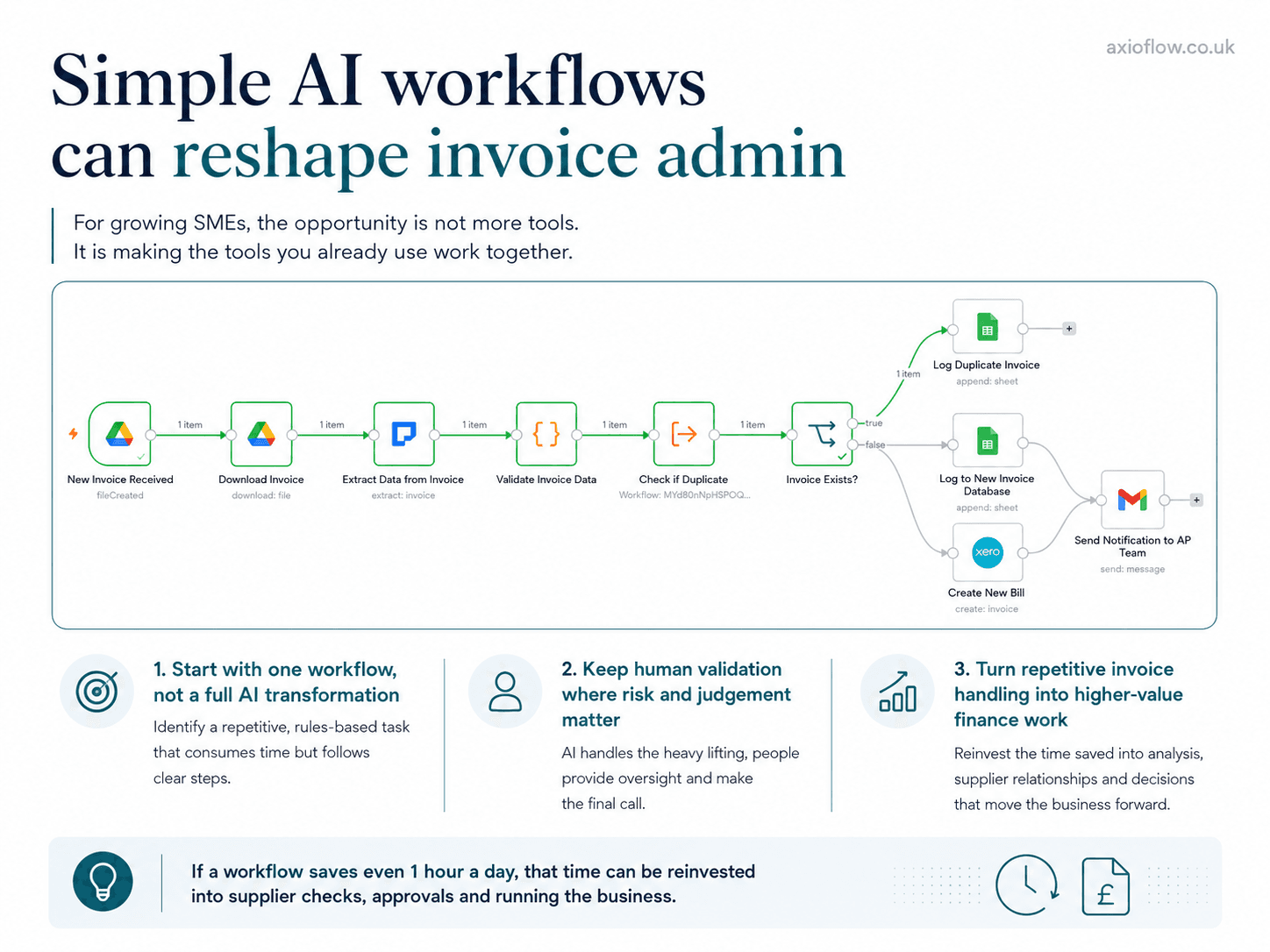
How a Simple Invoice Workflow Can Give SMEs Hours Back Every Week
Invoice processing becomes painful not because any single task is hard, but because the same small manual steps repeat every day. Here is what a better workflow looks like.